The What, Why, and How of Energy Management
This article explains what "energy management" is, why it's important, and how you can use it to save energy.
We'll start with the "what", and then move on to the "why", and the "how":
What is energy management?
"Energy management" is a term that has a number of meanings, but we're mainly concerned with the one that relates to saving energy in businesses, public-sector/government organizations, and homes:
The energy-saving meaning
When it comes to energy saving, energy management is the process of monitoring, controlling, and conserving energy in a building or organization. Typically this involves the following steps:
- Metering your energy consumption and collecting the data.
- Finding opportunities to save energy, and estimating how much energy each opportunity could save. You would typically analyze your meter data to find and quantify routine energy waste, and you might also investigate the energy savings that you could make by replacing equipment (e.g. lighting) or by upgrading your building's insulation.
- Taking action to target the opportunities to save energy (i.e. tackling the routine waste and replacing or upgrading the inefficient equipment). Typically you'd start with the best opportunities first.
- Tracking your progress by analyzing your meter data to see how well your energy-saving efforts have worked.
(And then back to step 2, and the cycle continues...)
To confuse matters, many people use "energy management" to refer specifically to those energy-saving efforts that focus on making better use of existing buildings and equipment. Strictly speaking, this limits things to the behavioural aspects of energy saving (i.e. encouraging people to use less energy by raising energy awareness), although the use of cheap control equipment such as timer switches is often included in the definition as well.
The above four-step process applies either way – it's entirely up to you whether you consider energy-saving measures that involve buying new equipment or upgrading building fabric.
Other meanings

Photo by Valerie Everett
It's not just about saving energy in buildings – the term "energy management" is also used in other fields:
- It's something that energy suppliers (or utility companies) do to ensure that their power stations and renewable energy sources generate enough energy to meet demand (the amount of energy that their customers need).
- It's used to refer to techniques for managing and controlling one's own levels of personal energy. We're far from qualified to say anything more about this!
- It also has relevance in aviation – it's a skill that aircraft pilots learn in some shape or form. We know nothing about aircraft energy management, but we can at least manage a picture of a man on a plane...
Anyway, from now on we will pay no more attention to these other definitions – all further references to "energy management" will be to the energy-saving sort described above.
Home energy management
Whilst energy management has been popular in larger buildings for a long time, it has only recently started catching on in homes. Most homeowners aren't even aware of the term, and take more of a haphazard, flying-blind approach to reducing their energy consumption...
But the monitoring- and results-driven approach used by professional energy managers is just as effective in the home as it is in larger buildings.
So, if you're a homeowner looking to save energy, don't be put off by the fact that this article focuses more on non-residential buildings. Most of the principles that apply to businesses and other organizations are also applicable to homes. Certainly the four-step process introduced above and detailed below is entirely applicable to home energy management.
Why is it important?
Energy management is the key to saving energy in your organization. Much of the importance of energy saving stems from the global need to save energy – this global need affects energy prices, emissions targets, and legislation, all of which lead to several compelling reasons why you should save energy at your organization specifically.
The global need to save energy
If it wasn't for the global need to save energy, the term "energy management" might never have even been coined... Globally we need to save energy in order to:
- Reduce the damage that we're doing to our planet, Earth. As a human race we would probably find things rather difficult without the Earth, so it makes good sense to try to make it last.
- Reduce our dependence on the fossil fuels that are becoming increasingly limited in supply.
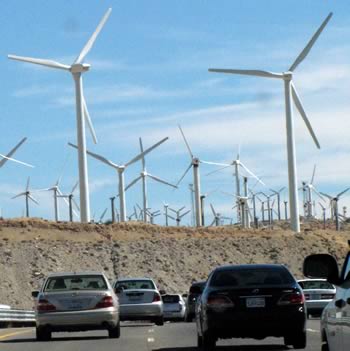
Photo by Kevin Dooley
Controlling and reducing energy consumption at your organization
Energy management is the means to controlling and reducing your organization's energy consumption... And controlling and reducing your organization's energy consumption is important because it enables you to:
- Reduce costs – this is becoming increasingly important as energy costs rise.
- Reduce carbon emissions and the environmental damage that they cause – as well as the cost-related implications of carbon taxes and the like, your organization may be keen to reduce its carbon footprint to promote a green, sustainable image. Not least because promoting such an image is often good for the bottom line.
- Reduce risk – the more energy you consume, the greater the risk that energy price increases or supply shortages could seriously affect your profitability, or even make it impossible for your business/organization to continue. With energy management you can reduce this risk by reducing your demand for energy and by controlling it so as to make it more predictable.
On top of these reasons, it's quite likely that you have some rather aggressive energy-consumption-reduction targets that you're supposed to be meeting at some worrying point in the near future... Your understanding of effective energy management will hopefully be the secret weapon that will enable you to meet those aggressive targets...
How best to manage your energy consumption?
We identified four steps to the energy-management process above. We'll cover each of them in turn:
1. Metering your energy consumption and collecting the data
As a rule of thumb: the more data you can get, and the more detailed it is, the better.
The old school approach to energy-data collection is to manually read meters once a week or once a month. This is quite a chore, and weekly or monthly data isn't nearly as good the data that comes easily and automatically from the modern approach...
The modern approach to energy-data collection is to fit interval-metering systems that automatically measure and record energy consumption at short, regular intervals such as every 15-minutes or half hour. There's more about this on our page about interval data.
Detailed interval energy consumption data makes it possible to see patterns of energy waste that it would be impossible to see otherwise. For example, there's simply no way that weekly or monthly meter readings can show you how much energy you're using at different times of the day, or on different days of the week. And seeing these patterns makes it much easier to find the routine waste in your building.
2. Finding and quantifying opportunities to save energy
The detailed meter data that you are collecting will be invaluable for helping you to find and quantify energy-saving opportunities. We've written an article that explains more about how to analyze your meter data to find energy waste.
The easiest and most cost-effective energy-saving opportunities typically require little or no capital investment.
For example, an unbelievable number of buildings have advanced control systems that could, and should, be controlling HVAC well, but, unbeknown to the facilities-management staff, are faulty or misconfigured, and consequently committing such sins as heating or cooling an empty building every night and every weekend.
(NB "HVAC" is just an industry acronym for Heating, Ventilation and Air Conditioning. It's a term that's more widely used in some countries than others.)
And one of the simplest ways to save a significant amount of energy is to encourage staff to switch equipment off at the end of each working day.
Looking at detailed interval energy data is the ideal way to find routine energy waste. You can check whether staff and timers are switching things off without having to patrol the building day and night, and, with a little detective work, you can usually figure out who or what is causing the energy wastage that you will inevitably find.
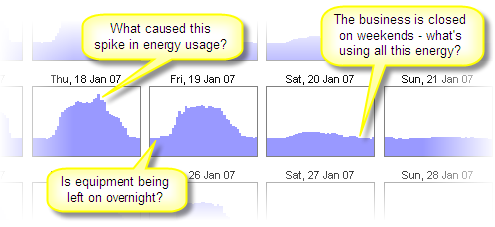
And, using your detailed interval data, it's usually pretty easy to make reasonable estimates of how much energy is being wasted at different times. For example, if you've identified that a lot of energy is being wasted by equipment left on over the weekends, you can:
- Use your interval data to calculate how much energy (in kWh) is being used each weekend.
- Estimate the proportion of that energy that is being wasted (by equipment that should be switched off).
- Using the figures from a and b, calculate an estimate of the total kWh that are wasted each weekend.
Alternatively, if you have no idea of the proportion of energy that is being wasted by equipment left on unnecessarily, you could:
- Walk the building one evening to ensure that everything that should be switched off is switched off.
- Look back at the data for that evening to see how many kW were being used after you switched everything off.
- Subtract the target kW figure (ii) from the typical kW figure for weekends to estimate the potential savings in kW (power).
- Multiply the kW savings by the number of hours over the weekend to get the total potential kWh energy savings for a weekend.
Also, most buildings have open to them a variety of equipment- or building-fabric-related energy-saving opportunities, most of which require a more significant capital investment. You are probably aware of many of these, such as upgrading insulation or replacing lighting equipment, but good places to look for ideas include the Carbon Trust and Energy Star websites.
Although your detailed meter data won't necessarily help you to find these equipment- or building-fabric-related opportunities (e.g. it won't tell you that a more efficient type of lighting equipment exists), it will be useful for helping you to quantify the potential savings that each opportunity could bring. It's much more reliable to base your savings estimates on real metered data than on rules of thumb alone. And it's critically important to quantify the expected savings for any opportunity that you are considering investing a lot of time or money into – it's the only way you can figure out how to hone in on the biggest, easiest energy savings first.
3. Targeting the opportunities to save energy
Just finding the opportunities to save energy won't help you to save energy – you have to take action to target them...
For those energy-saving opportunities that require you to motivate the people in your building, our article on energy awareness should be useful. It can be hard work, but, if you can get the people on your side, you can make some seriously big energy savings without investing anything other than time.
As for those energy-saving opportunities that require you to upgrade equipment or insulation: assuming you've identified them, there's little more to be said. Just keep your fingers crossed that you make your anticipated savings, and be thankful that you don't work for the sort of organization that won't invest in anything with a payback period over 6 months.
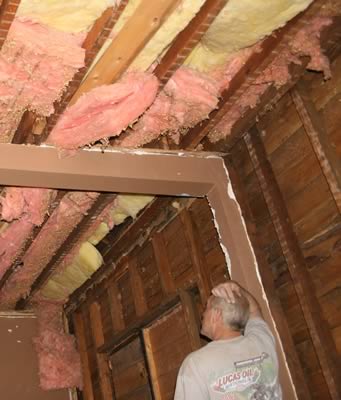
Photo by Alana Elliott
4. Tracking your progress at saving energy
Once you've taken action to save energy, it's important that you find out how effective your actions have been:
- Energy savings that come from behavioural changes (e.g. getting people to switch off their computers before going home) need ongoing attention to ensure that they remain effective and achieve their maximum potential.
- If you've invested money into new equipment, you'll probably want to prove that you've achieved the energy savings you predicted.
- If you've corrected faulty timers or control-equipment settings, you'll need to keep checking back to ensure that everything's still working as it should be. Simple things like a power cut can easily cause timers to revert back to factory settings – if you're not keeping an eye on your energy-consumption patterns you can easily miss such problems.
- If you've been given energy-saving targets from above, you'll need to provide evidence that you're meeting them, or at least making progress towards that goal...
- And occasionally you might need to prove that progress isn't being made (e.g. if you're at your wits' end trying to convince the decision makers to invest some money into your energy-management drive).
Our article on energy-performance tracking explains how best to analyze your metered energy data to see how well you're making progress at saving energy. Like step 2, this step is one that our Energy Lens software has been specifically designed to help with.
Managing your energy consumption effectively is an ongoing process...
At the very least you should keep analyzing your energy data regularly to check that things aren't getting worse. It's pretty normal for unwatched buildings to become less efficient with time: it's to be expected that equipment will break down or lose efficiency, and that people will forget the good habits you worked hard to encourage in the past...
So at a minimum you should take a quick look at your energy data once a week, or even just once a month, to ensure that nothing has gone horribly wrong... It's a real shame when easy-to-fix faults such as misconfigured timers remain unnoticed for months on end, leaving a huge energy bill that could have easily been avoided.
But ideally your energy-management drive will be an ongoing effort to find new opportunities to target (step 2), to target them (step 3), and to track your progress at making ongoing energy savings (step 4). Managing your energy consumption doesn't have to be a full-time job, but you'll achieve much better results if you make it part of your regular routine.
What next?
If you found this article useful, might you consider telling your colleagues or mentioning it on your website?
You might also be interested in our other articles on energy management / energy monitoring and targeting.
And you might like to take a look at our Energy Lens software – it's a big help for finding energy waste (step 2) and tracking progress at making savings (step 4):
- See how businesses and other organizations can use Energy Lens to help manage their energy consumption.
- Take a look at some of the charts of energy consumption that Energy Lens makes.
- Download the free trial of Energy Lens.